All posts by Trevor Carlsen

Cited in the print edition of the Wall Street Journal

Having one of my publications cited is always a pleasure, but the most recent citation feels extra special. The Wall Street Journal has long been my favorite newspaper. Not only did the Editorial Board pick up my research paper, but they mentioned me by name! Perhaps this is old hat for some writers, but it is a first for me.

The editorial was first published online and also appeared in the October 1, 2025, print edition.

The Wall Street Journal Editorial Board. Print edition Oct. 1, 2025

CBO doesn’t have a crystal ball

Congress often looks to the Congressional Budget Office (CBO) to score legislation as if it has a crystal ball. But many CBO scores have missed the mark. A newly released paper I contributed to for FGA reviews some examples of these blunders. CBO cost estimates are useful to lawmakers, but they should be viewed critically and cautiously.

Thoughts on the Giants’ revamped rotation

Recently, I suggested a savvy option for the Giants to upgrade their starting rotation. Thankfully, they went in a different direction and landed the reigning National League Cy Young award winner Blake Snell. In fairness to my position, at the time of my writing, I still thought Snell would be a good signing. Here’s how I ended that post:

I would certainly be happy with the Giants signing either Snell or Montgomery–heck, go for both–but I also understand the constraints. The bottom line is that the Giants need a starter, and Michael Lorenzen would be a good fit to fill that need.

– Me (two weeks ago)

But I was also well aware that the Giants have had their struggles landing the big name free agents lately. Last winter included the major disappointments of Aaron Judge resigning with the Yankees and the mega deal for Carlos Correa disintegrating overnight. This winter appeared to be going the same direction with both Shohei Ohtani and Yoshinobu Yamamoto agreeing to deals with the rival Dodgers (although, with Yamamoto getting shelled in his debut and the gambling drama surrounding Ohtani, neither seem like huge losses for the moment).

Even as the Giants and Snell remained a speculative pairing, the prospect became dimmer as the offseason wore on. The Giants had quietly made some moves on both sides of the ball and appeared to have assembled a rotation the team was comfortable rolling with to start the season. Or at the very least, they were comfortable selling it to the fan base–Snell is completely absent from a “Building the Giants Pitching Rotation” propaganda video that was released two days after he officially donned the orange and black.

All but a few sands in the Spring Training hour glass had fallen and other teams were also still in the mix. Until they weren’t. And Blake Snell was a Giant!

Even if Snell isn’t quite ready for Opening Day, his addition is a huge boost to a rotation that, in my opinion, was sporting more question marks than answers. According to MLB.com, having Snell in the fold merits ranking the Giants at number five in its rotations rankings–I think they should be higher.

Just a short time ago, the projected rotation looked much different. One projection penciled in the five spots this way:

  1. Logan Webb
  2. Ross Stripling
  3. Kyle Harrison
  4. Tristan Beck
  5. Keaton Winn

Between injuries and roster moves, including the Blake Snell addition, it’ll be a much different look (at least on paper, the placements might be off to start the season while guys get settled in).

  1. Logan Webb
  2. Blake Snell
  3. Jordan Hicks
  4. Kyle Harrison
  5. Keaton Winn

Things will look even different when/if everyone comes back healthy and the pitching staff is at full strength. Alex Cobb is reportedly ahead of schedule and Robbie Ray is still expected back in the second half. Having an All Star and Cy Young winner waiting in the wings gives the Giants an even more formidable rotation and plenty of depth.

I am always optimistic heading into a new baseball season, but I’m especially excited thanks to the pitching and defensive moves the front office made. The old adage, defense wins championships, is true. Pithing and defense were at the core of the 2010, 2012, and 2014 World Series Championships. That should be the model. Especially with the Giants playing half of their games at Oracle Park. Between the pitching upgrades and a left side of the infield sporting multiple Gold Gloves, the Giants could be on their way to competing for another Fall Classic.

The rematch? More like the comeback

Earlier this week, President Biden and former President Trump sewed up their respective nominations seemingly setting up a rematch of or sequel to the 2020 election. I say “seemingly” because I posit that it’s still possible, and I think likely, that the Democrat replace Biden at the Democratic National Convention, but I digress.

With the presumptive nominees now set, the notion of “the rematch” deserves some attention. The country already got one 2020 repeat earlier this year, when the San Francisco 49ers took on the Kansas City Chiefs in the Super Bowl. That did not go as I had hoped with the outcome also repeating itself as the Chiefs hoisted the Lombardi Trophy. Between the football and politics, 2024 is seemingly on a path to being “déjà vu all over again,” as Yogi Berra would say.

But Trump’s 2024 return to the ballot to take on his 2020 challenger is more than just a rematch. Billing it simply as just one of now seven repeat matchups misses an important characteristic: Trump is a former president! In most of those previous instances, the “rematch” involved a non-president taking on the incumbent he lost against before. The closest thing the repeat candidates had to presidential experience was losing their previous shot at the presidency.

For example, the perennial presidential candidate of the early 20th Century, William Jennings Bryan, one of the “rematch” examples (having matched up against William McKinley twice, and lost), never had the privilege of running as a former president. To return to a football comparison, William Jennings Bryan is the 90s Buffalo Bills of presidential nominees. The Bills represented the AFC in four straight Super Bowls from XXV to XXVIII, and they proceeded to lose every single one to the NFC East. It’s not a perfect analogy, because the Democrats had the good sense to nominate someone other than Bryan in 1904, but it’s still an apt comparison. The Bills might have made it to “the big dance” several times, but they were never Super Bowl Champions. The same can be said of Bryan who was a three-time nominee who never ascended to the presidency.

Notably, the Trump-Biden rematch differs in that President Trump has been America’s chief executive before. For that reason, 2024 is better considered a presidential comeback! And for that, there is only one comparison–the 1896 presidential rematch between incumbent Benjamin Harrison and former president Grover Cleveland, the outcome of which made President Cleveland the only nonconsecutive two-time president (so far).

With that, to prepare yourself for the upcoming election with a historical view, I recommend adding a Cleveland biography to your reading list. My choice, and a book I began reading this week, is A Man of Iron: The Turbulent Life and Improbable Presidency of Grover Cleveland by Troy Senik.

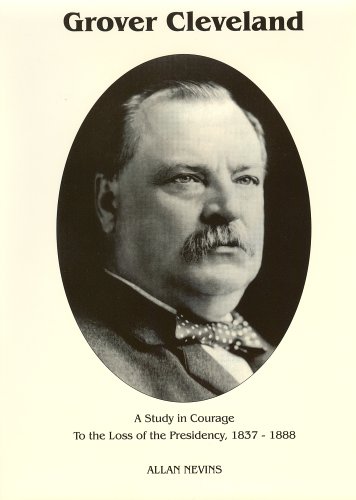
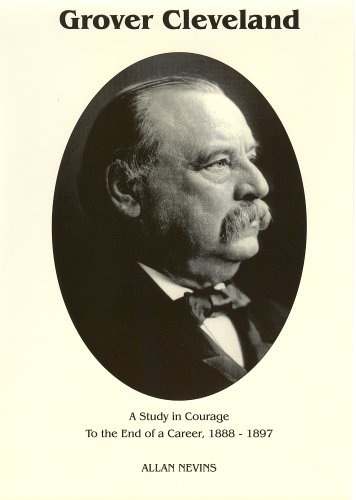
Alternatively, Allan Nevins’ 1933 Pulitzer Prize winning two-volume biography Grover Cleveland: A Study in Courage, which I read in 2022 in anticipation of this probability, is also a great choice.

To the Loss of the Presidency (Grover Cleveland a Study in Courage, Vol. 1) on Amazon: https://a.co/d/gsGMcFz
To the End of a Career (Grover Cleveland a Study in Courage, Vol. 2) on Amazon: https://a.co/d/gj1hLG7

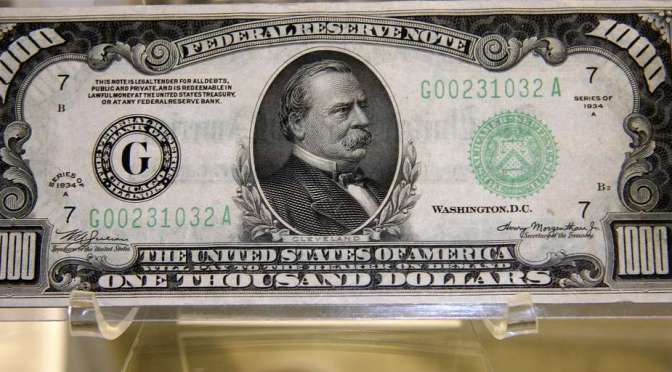
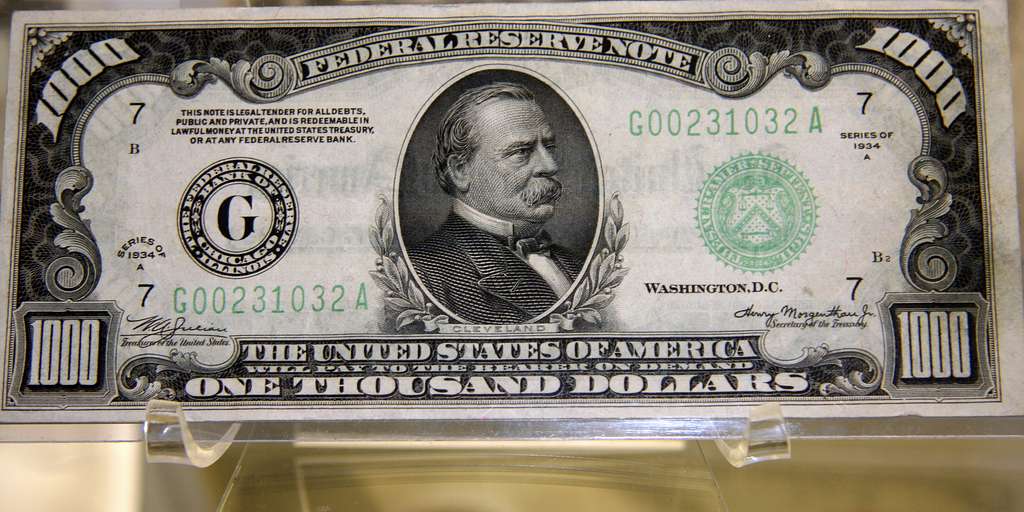
A closing fun fact: Grover Cleveland was featured on the $1,000 bill.

Although the $1,000 has been discontinued, the level of inflation since Biden took office might be making the case for out-of-circulation, high denomination bills, like the McKinley ($500 bill) and the Cleveland ($1,000), to make their own comeback.

The Giants should start the season with another starter in the rotation

Heading into the 2024 season, the Giants’s rotation was certainly in need of an upgrade. The 2023 starters were below average in quality starts (6 innings and fewer than 3 runs) and ranked third from the bottom in wins in games started. Some of that statistical poor showing has to do with the outsized use of the “opener.” Even still, Kapler’s reliance on the “opener,” in addition to him being a poor decision-maker, was mostly a symptom of a weak rotation–Wood, Manaea, and Stripling would have been starting games outright if they were performing.

But there were bright spots. Giants starters led the league in complete games (4), with Logan Webb (who should have been an All-Start and was the Cy Young runner-up) and Alex Cobb (first-time All-Start) logging two apiece. Both also threw for more than 150 innings (Webb led the league with 216 innings pitched). As spring training rolls along, Webb is a lock to make his third consecutive Opening Day start.

Some of the necessary changes have been made. All of the “featured pitchers” from the “opener” experiments have gone elsewhere. The Giants landed the 2021 Cy Young winner Robbie Ray by trading injury-ridden Anthony DeSclafani and outfielder Mitch Haniger to Seattle. They also brought on flame-throwing right-hander Jordan Hicks on a four-year deal with the intention of using him as a starting pitcher.

If everyone was healthy, the starting rotation would look something like this:
1. Logan Webb
2. Robbie Ray
3. Alex Cobb
4. Jordan Hicks
5. Kyle Harrison

But with less than a month before Opening Day, the Giants are rolling in with a skeleton crew. Instead, the rotation is:
1. Logan Webb (lock)
2. Jordan Hicks (reliever turned starter)
3. Kyle Harrison (unproven)
4. ?
5. ?

And after spring training injuries have taken their toll, some of the leading contenders for those rotation slots to fill in for Ray and Cobb are now on the shelf themselves. The Giants should add another starting pitcher!

The three names that I’ve heard most frequently linked to the Giants are Blake Snell, Jordan Montgomery, and Michael Lorenzen. At this juncture, I think Lorenzen makes the most sense.

There are a couple of different ways to go about constructing a roster. One approach is to stockpile talent and sign the best players regardless of position and then try to move talent around after the fact. That seems to be what the Giants did with their signing of Matt Chapman despite already having a quality starting third baseman on the roster. On the one hand, you’ve got a better team (at least on paper) and plenty of depth. But there are constraints to stockpiling talent. After all, there are only 9 spots on the lineup card and only 9 innings per game (usually) for pitchers to pitch.

If the Giants want to stick with the “most talented” approach, they should nab Snell or Montgomery. Statistically, they had the better 2023 campaigns–although, of the trio, Lorenzen was the only All-Star. But given the current roster, Lorenzen makes plenty of sense. He would slot in as a quality starter immediately, but he would also be a good depth piece for a rotation with injury issues and several question marks. As players return from injury, he could remain a starter or, given his experience as a set-up man, move to the bullpen. That kind of flexibility is helpful over a 162-game marathon is a tremendous asset. He’s also viewed as a more cost-effective option. MLBTR predicted a two-year, $22 MM contract earlier in the offseason.

Lorenzen had his struggles last year, mostly in the second half, but he also had flashes of brilliance, e.g., throwing a no-hitter in his second start after being traded to the Phillies. It’s possible that those struggles were a consequence of wearing down. Before last season, he had only thrown more than 100 innings once in his career, and that was his rookie season with the Reds back in 2015. If the Giants bring him aboard, he’ll pencil in at the back end of the rotation, where usage and late-season fatigue will be of less concern.

I would certainly be happy with the Giants signing either Snell or Montgomery–heck, go for both–but I also understand the constraints. The bottom line is that the Giants need a starter, and Michael Lorenzen would be a good fit to fill that need.

The Giants bring on Matt Chapman

After all the speculation and rumors linking Matt Chapman to the San Francisco Giants, the four-time gold glove third baseman is finally headed back to the Bay.

Time will tell if this move pays off. I have my doubts.

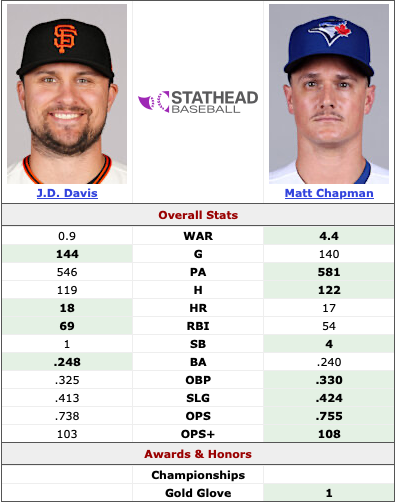
The Giants already have incumbent third baseman J.D. Davis on the roster for a more modest salary. While Chapman is reportedly coming in on a three-year, $54 million contract ($20 million in 2024), Davis is only slated to take home $6.9 million this season. Does Chapman improve the roster by the additional $13 million he’ll be paid next year?

Measured by career numbers, Chapman certainly has the edge on Davis. Both players are the same age, but Chapman has logged significantly more major league experience. He’s also more impressive defensively.

But more recent numbers paint a picture of Chapman as a more expensive Davis with a better glove. In fewer plate appearances last season, Davis put up comparable numbers and was also vying for a spot on the NL All-Star team before coming up short in voting for the Summer Classic.

Chapman’s defensive prowess cannot be ignored. Last season, the Giants were the worst team defensively, logging 117 errors. While Davis contributed to that total with 9 errors of his own, his numbers do not look all that different from Chapman’s (who won his fourth gold glove last season). Chapman recorded 12 errors across 1214 innings at third base (300 more than Davis, who also spent 30 games between first base and DH) and .968 FPCT. Davis had a .967 FPCT at third base and although he clocks in below Chapman on the “range factor” metric, he made strides in the field last season and proved to be a capable defensive third baseman.

Some speculated that signing Chapman and his superior glove makes even more sense, given the uncertainty surrounding Marco Luciano as the heir apparent at shortstop. However, it seemed to me that the Giants had already hedged against that by bringing in two-time Gold Glove winner Nick Ahmed on a minor league contract.

Because Davis can also play first base, the Giants could retain him in more of a utility and depth role, but that route is complicated by the presence of Wilmer Flores.

While it’s true that Wilmer is more of a defensive liability at the hot corner (a .928 fielding percentage and a career-low .848 in 2023), he’s coming off of a great offensive second half and has been the clubhouse guy that successful teams need. Look no further than his recruitment efforts to bring on Jorge Soler — a bat that would encroach on Wilmer’s DH opportunities — as evidence of his team-first mentality. With a 2024 salary of $6.5 million, he is also the lowest-priced of the three. If the Chapman signing spells the end of Wilmer’s time in San Francisco, then count me out on the deal.

The bottom line: The Chapman signing raises just as many questions as it answered. The Giants now have a surplus at third base and making a trade to clear up defensive assignments seems to be the next order of business. But who are the Giants going to part with, and what can they expect in return? Seemingly, the Giants will be able to find a suitor, but will that trade fill other pressing roster needs, i.e. starting pitching, and balance out Chapman’s more expensive contract?

Signing Matt Chapman could be the right move. He is a team leader and has history with new manager Bob Melvin from their time together in Oakland. As the 2024 season progresses, an offensive resurgence and Chapman’s intangibles might prove he’s worth the money. As a Giants fan, I’ll hope for the best, but I’m skeptical that this was much of an improvement.

New Article in the Federalist

Today, the Federalist published an article by my colleague Stewart Whitson and me discussing the House Committee on Administration’s recent hearing on Zuckerbucks and what states and Congress can do to prevent election interference. The Federalist has done a tremendous job shedding light on threats to election integrity, and I’m glad to be contributing to their continued efforts.

The article is available here: https://thefederalist.com/2024/02/22/congress-must-stop-the-big-corporate-election-interference-it-didnt-in-2020/.

New research paper out today: Americans Deserve New Health Options—And Policymakers Can Deliver

Today, the Foundation for Government Accountability published my paper, coauthored by Hayden Dublois, explaining how policymakers can offer more affordable coverage options by creating a new Individual Coverage Health Reimbursement Arrangement (ICHRA)-anchored insurance pool. The reform proposal further recommends offering flexibility for out-of-network care, requiring the disclosure of lower cash prices, and codifying some of the regulations issued during the Trump administration, specifically the association health plans and short-term plans final rules. The paper is available on FGA’s website.

Moving to Music City

I moved to the East Coast in the fall of 2012. Almost 11 years to the day (according to Facebook Memories), I’ve made my departure–at least temporarily. Last Monday, I put most of my belongings in a storage unit, loaded the rest in the back of my pickup, and made the 600+ mile drive to Nashville, TN where I’ll be residing for the immediate future. My plan is to explore as much of Music City as I can over the next month or so.

The trip down here was mostly uneventful. I listened to music (country, of course) and podcasts (mostly catching up on EconTalk). The highlight of the drive was rolling into a gas station practically on empty. And while that kind of reminded me of the scene from Seinfeld where Kramer test drives a car and tries to see how long it can run on E, that wasn’t why it was the highlight.

The real joy was making it Buc-ee’s! Gas there was only $3.14/gal which seems like a steal compared to gas prices in the DMV (about 3.80/gal) and my home state of California (nearly $5.80/gal).

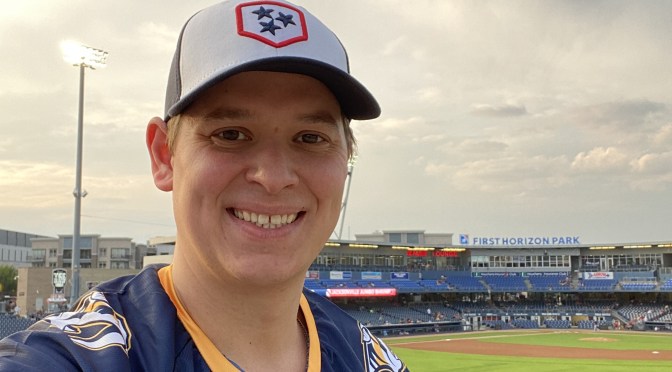
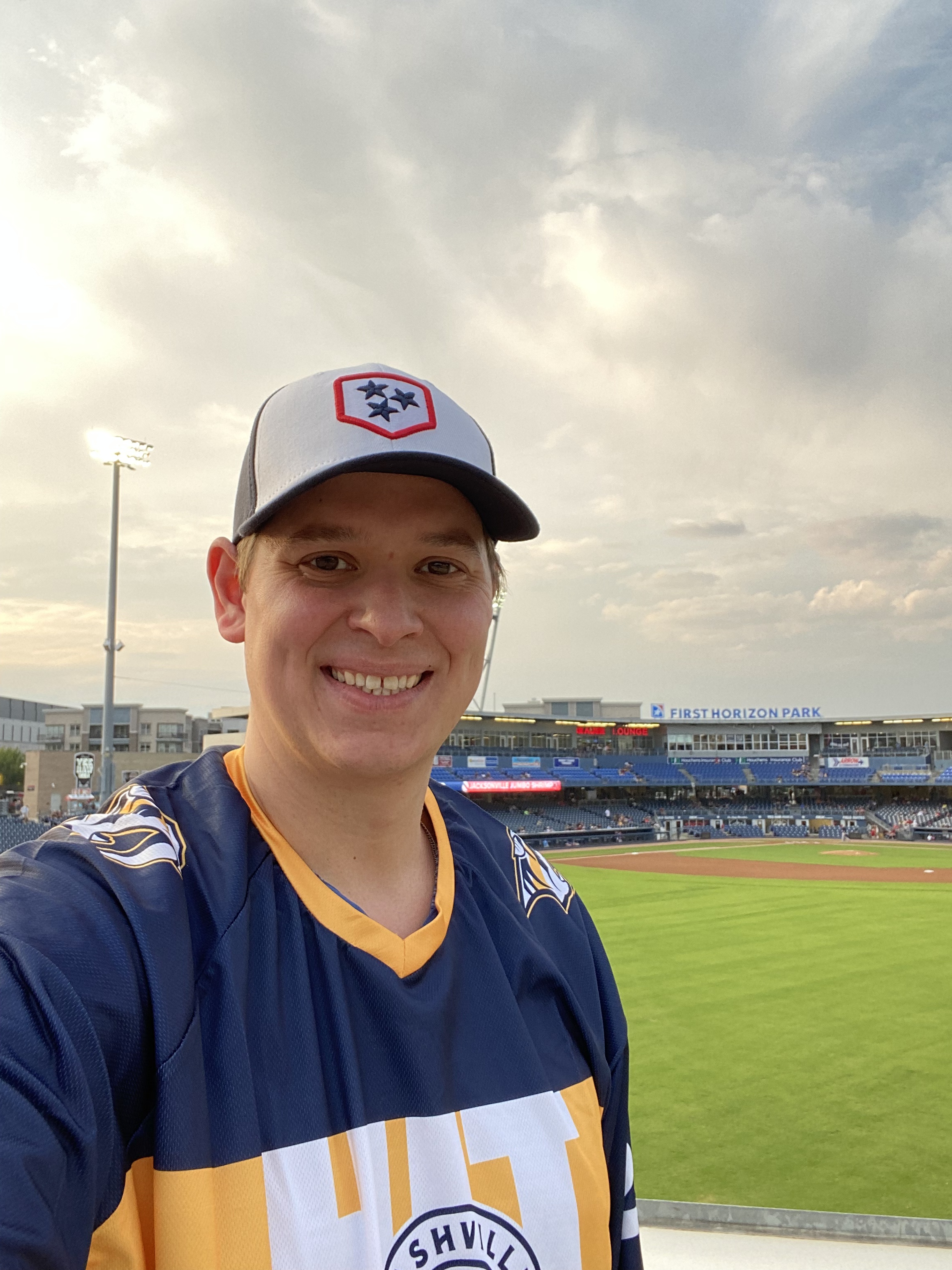
I’ve only been in here a week, but I’ve been trying to get in some authentic Nashville experiences. I had HattieB’s (not pictured) for dinner on my first night–the Shut the Cluck Up is not for the faint of heart. I also caught a Nashville Sounds game (Nashville Sounds are a minor league affiliate of the Milwaukee Brewers).

The “Hit City” Predators jersey was a giveaway (obviously, I’m still a Sharks fan), but I did treat myself to the Nashville Sounds ball cap. And I even got to see a familiar face!

Darin Ruf played for the Giants and was a key contributor to their 107-win season, which was a career year for him. Excitingly, the Sounds won and are now 1-0 when I’m in attendance.

Over the weekend, I caught up with my friend and former officemate Sam, who runs Rise Strength and Performance, a gym east of Nashville. I got to join for the Saturday morning workout and ice bath.

Last but not least, I attended Traditional Latin Mass at the Catholic Church of the Assumption of the Blessed Virgin Mary in Germantown.

Unfortunately, the church was damaged by a tornado in 2020 and remains under construction (more about the parish here), so Mass is currently being celebrated in the chapel across the street.

Some additional history: Coinciding with my arrival at the parish is the opening of a new park on the property. It was recently announced that the park is to be named Bliemal Park, after the Revered Emmeran Bliemal, who was the pastor of the Church of the Assumption during the Civil War. More about Rev. Bliemal here.

Not a bad first week! I’m off to Maine for a work trip this week but plan to see more of Nashville and make it to the honky-tonks next weekend.

The federal government’s Medicaid handcuffs are costing states

Last week, the New York Post published an opinion piece by me and one of my colleagues where we lay out the case for states to reject a temporary bump in their Medicaid match rate because it’s actually a bad deal for states. Since the extra money comes with massive strings attached, accepting the increase in federal funding is costing states more than they are getting from the FMAP bump. The New York Post piece is based on our analysis published in our Foundation for Government Accountability report.

The bottom line: Many states made the prudent decision to opt out of the federal pandemic unemployment bonus because continuing on with the federal government’s policy was causing more harm than good. States handcuffed by new federal restrictions should similarly opt out of the Medicaid financing bump so that they can get their Medicaid programs back on track.

The Washington Post article is available here.

The FGA paper is available here.