Category Archives: Politics

Cited in the print edition of the Wall Street Journal

Having one of my publications cited is always a pleasure, but the most recent citation feels extra special. The Wall Street Journal has long been my favorite newspaper. Not only did the Editorial Board pick up my research paper, but they mentioned me by name! Perhaps this is old hat for some writers, but it is a first for me.

The editorial was first published online and also appeared in the October 1, 2025, print edition.

The Wall Street Journal Editorial Board. Print edition Oct. 1, 2025

The rematch? More like the comeback

Earlier this week, President Biden and former President Trump sewed up their respective nominations seemingly setting up a rematch of or sequel to the 2020 election. I say “seemingly” because I posit that it’s still possible, and I think likely, that the Democrat replace Biden at the Democratic National Convention, but I digress.

With the presumptive nominees now set, the notion of “the rematch” deserves some attention. The country already got one 2020 repeat earlier this year, when the San Francisco 49ers took on the Kansas City Chiefs in the Super Bowl. That did not go as I had hoped with the outcome also repeating itself as the Chiefs hoisted the Lombardi Trophy. Between the football and politics, 2024 is seemingly on a path to being “déjà vu all over again,” as Yogi Berra would say.

But Trump’s 2024 return to the ballot to take on his 2020 challenger is more than just a rematch. Billing it simply as just one of now seven repeat matchups misses an important characteristic: Trump is a former president! In most of those previous instances, the “rematch” involved a non-president taking on the incumbent he lost against before. The closest thing the repeat candidates had to presidential experience was losing their previous shot at the presidency.

For example, the perennial presidential candidate of the early 20th Century, William Jennings Bryan, one of the “rematch” examples (having matched up against William McKinley twice, and lost), never had the privilege of running as a former president. To return to a football comparison, William Jennings Bryan is the 90s Buffalo Bills of presidential nominees. The Bills represented the AFC in four straight Super Bowls from XXV to XXVIII, and they proceeded to lose every single one to the NFC East. It’s not a perfect analogy, because the Democrats had the good sense to nominate someone other than Bryan in 1904, but it’s still an apt comparison. The Bills might have made it to “the big dance” several times, but they were never Super Bowl Champions. The same can be said of Bryan who was a three-time nominee who never ascended to the presidency.

Notably, the Trump-Biden rematch differs in that President Trump has been America’s chief executive before. For that reason, 2024 is better considered a presidential comeback! And for that, there is only one comparison–the 1896 presidential rematch between incumbent Benjamin Harrison and former president Grover Cleveland, the outcome of which made President Cleveland the only nonconsecutive two-time president (so far).

With that, to prepare yourself for the upcoming election with a historical view, I recommend adding a Cleveland biography to your reading list. My choice, and a book I began reading this week, is A Man of Iron: The Turbulent Life and Improbable Presidency of Grover Cleveland by Troy Senik.

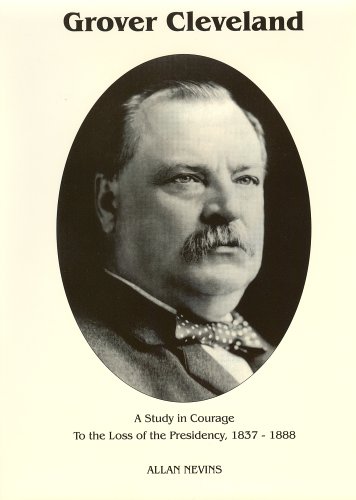
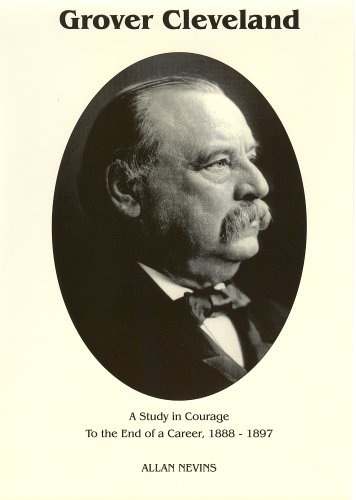
Alternatively, Allan Nevins’ 1933 Pulitzer Prize winning two-volume biography Grover Cleveland: A Study in Courage, which I read in 2022 in anticipation of this probability, is also a great choice.

To the Loss of the Presidency (Grover Cleveland a Study in Courage, Vol. 1) on Amazon: https://a.co/d/gsGMcFz
To the End of a Career (Grover Cleveland a Study in Courage, Vol. 2) on Amazon: https://a.co/d/gj1hLG7

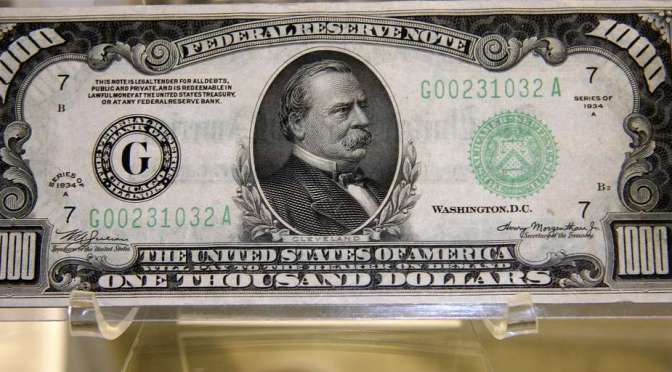
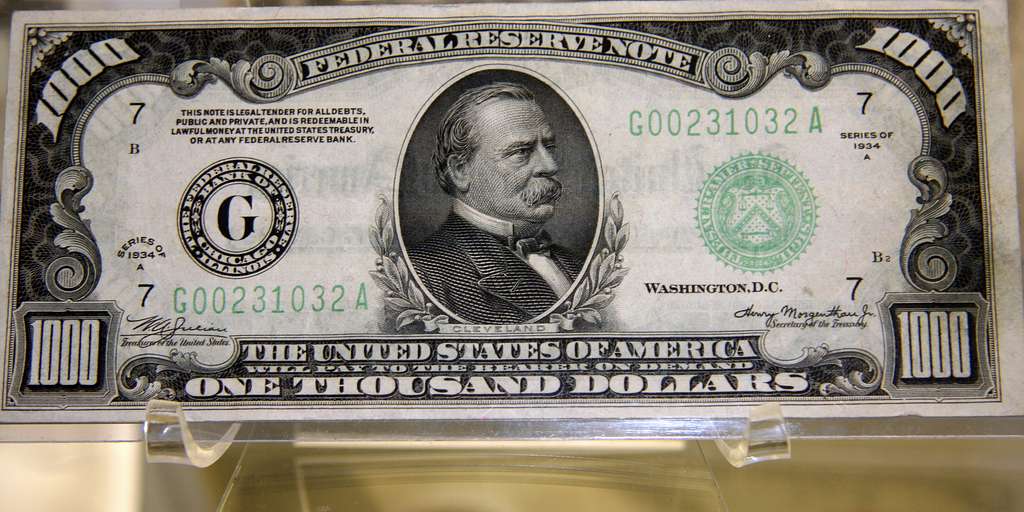
A closing fun fact: Grover Cleveland was featured on the $1,000 bill.

Although the $1,000 has been discontinued, the level of inflation since Biden took office might be making the case for out-of-circulation, high denomination bills, like the McKinley ($500 bill) and the Cleveland ($1,000), to make their own comeback.

New Article in the Federalist

Today, the Federalist published an article by my colleague Stewart Whitson and me discussing the House Committee on Administration’s recent hearing on Zuckerbucks and what states and Congress can do to prevent election interference. The Federalist has done a tremendous job shedding light on threats to election integrity, and I’m glad to be contributing to their continued efforts.

The article is available here: https://thefederalist.com/2024/02/22/congress-must-stop-the-big-corporate-election-interference-it-didnt-in-2020/.

New research paper out today: Americans Deserve New Health Options—And Policymakers Can Deliver

Today, the Foundation for Government Accountability published my paper, coauthored by Hayden Dublois, explaining how policymakers can offer more affordable coverage options by creating a new Individual Coverage Health Reimbursement Arrangement (ICHRA)-anchored insurance pool. The reform proposal further recommends offering flexibility for out-of-network care, requiring the disclosure of lower cash prices, and codifying some of the regulations issued during the Trump administration, specifically the association health plans and short-term plans final rules. The paper is available on FGA’s website.

The federal government’s Medicaid handcuffs are costing states

Last week, the New York Post published an opinion piece by me and one of my colleagues where we lay out the case for states to reject a temporary bump in their Medicaid match rate because it’s actually a bad deal for states. Since the extra money comes with massive strings attached, accepting the increase in federal funding is costing states more than they are getting from the FMAP bump. The New York Post piece is based on our analysis published in our Foundation for Government Accountability report.

The bottom line: Many states made the prudent decision to opt out of the federal pandemic unemployment bonus because continuing on with the federal government’s policy was causing more harm than good. States handcuffed by new federal restrictions should similarly opt out of the Medicaid financing bump so that they can get their Medicaid programs back on track.

The Washington Post article is available here.

The FGA paper is available here.

Virginia’s New Grocery Bag Tax Irritates Me

In the past, at the dawn of a new year, I have set myself a goal to write regularly. That plan has always fallen flat thanks to lack of discipline and deference to competing priorities – but mostly lack of discipline.

For 2022, I made no such plans. And yet, here I am typing away at my keyboard as if to meet a weekly writing goal. But this post is not about sticking to a regular writing schedule. It is, however, inspired by what leads many great columnists to stick to theirs – irritation.

According to Washington Post columnist George Will, when asked the question, “How do you come up with things to write about?” William F. Buckley Jr. replied, “The world irritates me three times a week.” The implication being: write about what irritates you, and you will have sufficient material for a regular column.

The world irritates me three times a week.

William F. Buckley Jr. on the question, “How do you come up with things to write about?” according to George F. Will.

The source of my irritation is the new grocery bag tax plaguing northern Virginia.

I am generally irritated by taxes, but I find this new tax all the more bothersome, thanks to its timing. Earlier this week, I returned from California, where I spent Christmas and the New Year with my family. Family time is always rewarding but trips to California also come with reminders that the state has a penchant for bad policy – including its ban on plastic bags.

Usually, I do not do much grocery shopping while I am home. My typical encounter with the market occurs as a tag-along when my parents are shopping or on a one-off visit to pick up a few ingredients needed for dinner.

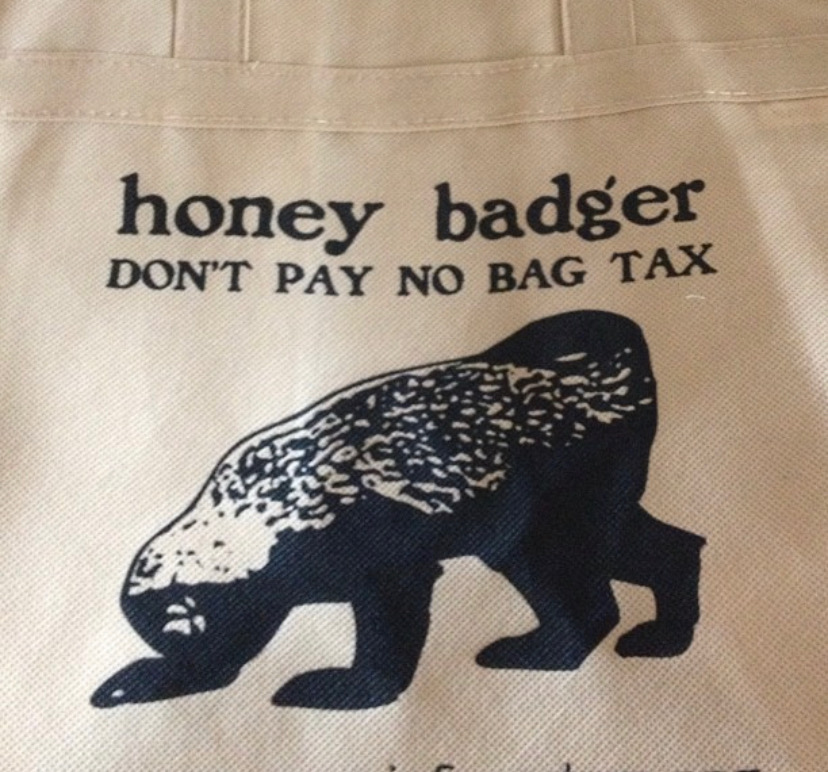
If I’m the one doing the buying, I grab only what I can carry without using a bag. Under the circumstances, I’m much more willing to shove items into my pockets and to walk away with overladen arms. Honey badger don’t pay no bag tax.

When I returned from my California visit, I thought I had left the plastic phobia behind me. Much to my dismay, at the self-checkout at my local grocery store in northern Virginia, I was confronted by a new prompt on the machine, asking me how many store-provided bags I used. It turns out, with the flip of the calendar, a new bag tax had taken effect.

Now, I tend to use reusable totes because they make it easier to carry my groceries on the walk home. But on this occasion, I was without my bags and found myself needing one that, a few days before, the store would have provided free of charge. So now, 10 cents later, I am irritated.

My opposition to the tax is more on principle than the cost. At 5 cents per bag, the tax will not break the bank. Regardless, it is still bad policy. Taxes should be about raising revenue to meet spending obligations, not social engineering. This new tax is really virtue signaling by Democratic politicians and environmental activists who circulated a petition to impose the tax following similar virtue signaling by the Virginia legislature and Democratic governor.

Arlington County, where I live, enacted the ordinance after receiving a petition with fewer than 1,500 signatories – not even 1 percent of registered voters.

A letter accompanying the petition claimed, “The plastic bag tax will encourage residents to shift to more sustainable, reusable bags…” Never mind that reusable bags are unhygienic and require nearly 200 years of regular use before achieving an overall environmental benefit.

I’m also dubious that the tax will reduce the prevalence of grocery bags that supposedly “litter our streets and open spaces.” When San Francisco banned single-use bags, the reduction in plastic bags comprising the city’s litter was statistically insignificant. Besides, the “nasty streets” of San Francisco have bigger problems than plastic bags.

Reportedly, revenue for the tax will be used for environmental cleanup programs, pollution and litter mitigation programs, educational programs, and to provide reusable bags to SNAP and WIC beneficiaries. But so what? If the tax is supposed to eliminate plastic bag usage, then the beneficiaries of the revenue are irrelevant. Really the tax pays for pet projects that make “environmentalists” feel good.

Of course, all of this ignores what the new tax portends for grocery-inspired comedy. Inevitably, grocery clerks will assume customers will want to avoid bagging large items such as the cumbersome gallon of milk. After all, it already comes equipped with a handle. As a result, they will forego the standard question: “Would you like the milk in a bag?” Leaving dad-joke aficionados without an opportunity to supply the always humorous response, “No, thanks. Just leave it in the container.”

Did anyone mention this to the petition signatories while they signed on to the death of comedy in exchange for an “environmentally friendly” bag tax?
New OP-ed – Don’t Expect Any State Flexibility Under Obama 2.0

Last week, RealClearHealth published my first Foundation for Government Accountability op-ed. I wrote about the bad news for states that expanded Medicaid now that the Biden Administration is running CMS. Upon entering office, Biden put states on notice that flexibilities allowed by the Trump Administration are gone. Importantly, states that have not expanded Medicaid can take note and be aware of this so they don’t suffer the same fate.

Check out the piece at RealClearHealth and on The Foundation for Government Accountability’s website.

https://www.realclearhealth.com/articles/2021/03/24/dont_expect_any_state_flexibility_under_obama_20_111179.html

Are you really that offended by your college’s mascot?

Apparently, George Washington is an offensive mascot. As reported by Campus Reform, students at George Washington University are petitioning to have the name changed on the grounds that the “Colonial” mascot may not be “the best identity for community school spirit.”

Source: Fox & Friends Facebook Page

One of the students interviewed in the Campus Reform video claimed, “there are students on this campus who don’t feel comfortable with it, so then, it doesn’t really matter what other students think.” To me, this raises the question, how offended can someone really be? Didn’t they voluntarily enroll at GW knowing full well that the mascot is the “Colonial”?

By all means, let’s have the debate over “offensive” mascots. But arguing that some are offended does not really justify a change. For one, it ignores the opinions of those who don’t have a problem, or even like the mascot. And what’s more, those who are offended by the name are not obliged to attend an institution whose traditions make them uncomfortable. With some 5,300 colleges to choose from, enrollees are hardly coerced to study there.

The offended students would do well to remember that they chose to enroll at GW University, “Colonial” mascot and all. If they had any qualms about the mascot, they clearly weren’t that significant. By enrolling, those students implicitly ranked their discomfort with the school’s mascot on a lower rung when considering the myriad trade-offs prospective students face. Had it been an important enough issue, the students would have given better consideration to that factor when making their enrollment decision.

This is not to say that schools and teams shouldn’t undergo name changes. As the GW Libraries website points out, the “Colonials” was not the original name used to refer to GW’s sports teams and the school itself was not always George Washington University. But the decision should not hinge on the discomfort of a few students.

As for ascribing the “Colonial” mascot to GW sports teams, a 1926 editorial from the school newspaper, The Hatchet, offers a pretty solid explanation for the name:

What name could be more fitting? This, the school named after George Washington, and having as its colors the Continental Army buff and blue, the colors of Colonial America, should be entitled to bear the name of “Colonials” if any school is so entitled. George Washington University, in its antecedents, is a colonial school. Dating back to very early post-Revolutionary days, it was founded when the term “colonial” still applied to an era which was then passing. Let us then, in just regard for our precious heritage, adopt as the name for the warriors wearing the Buff and Blue the term “Colonials.”

Excerpt from an editorial in the Hatchet from October 27, 1926. Source: https://library.gwu.edu/scrc/university-archives/gw-history/nicknames-and-mascots

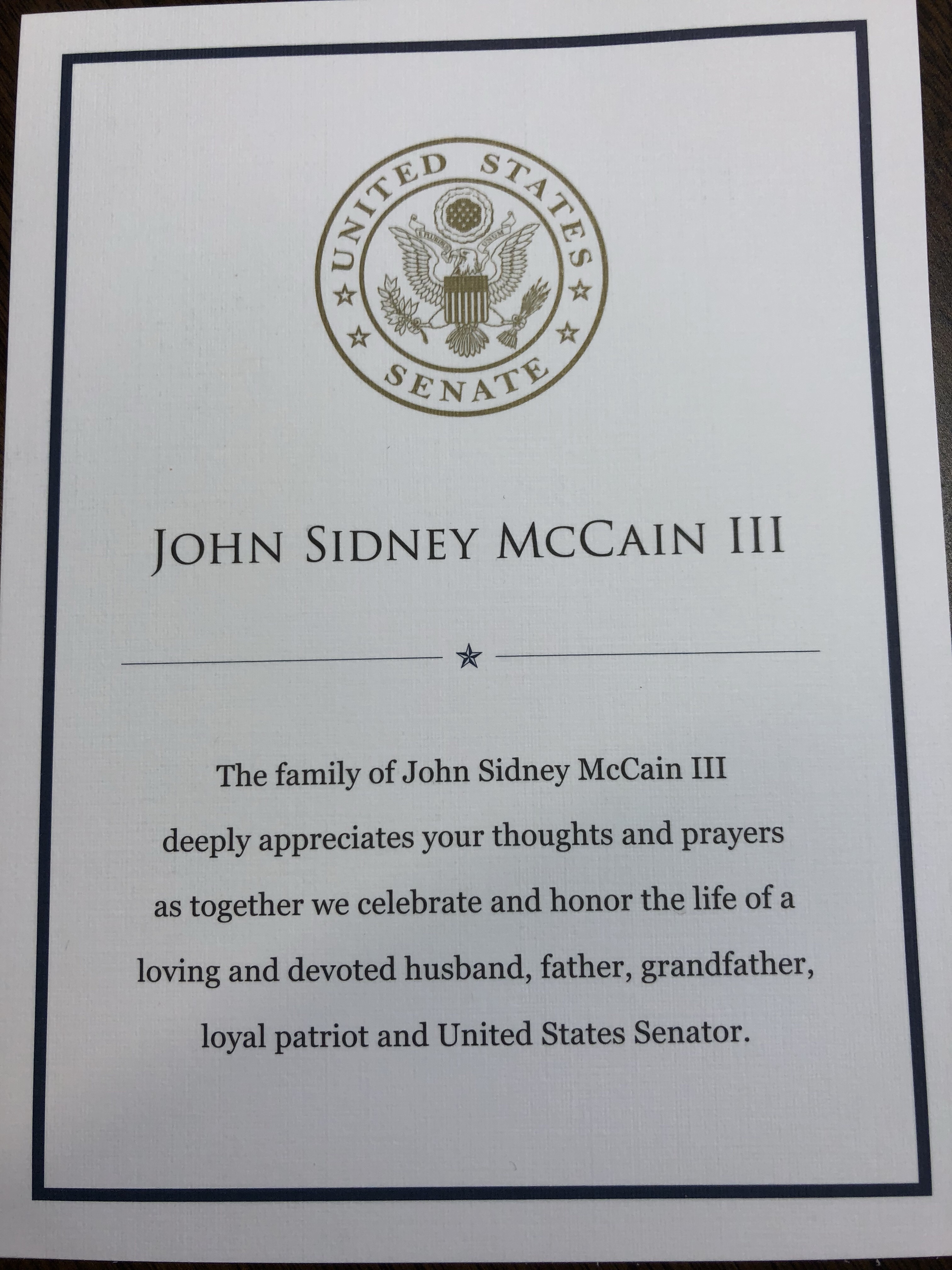
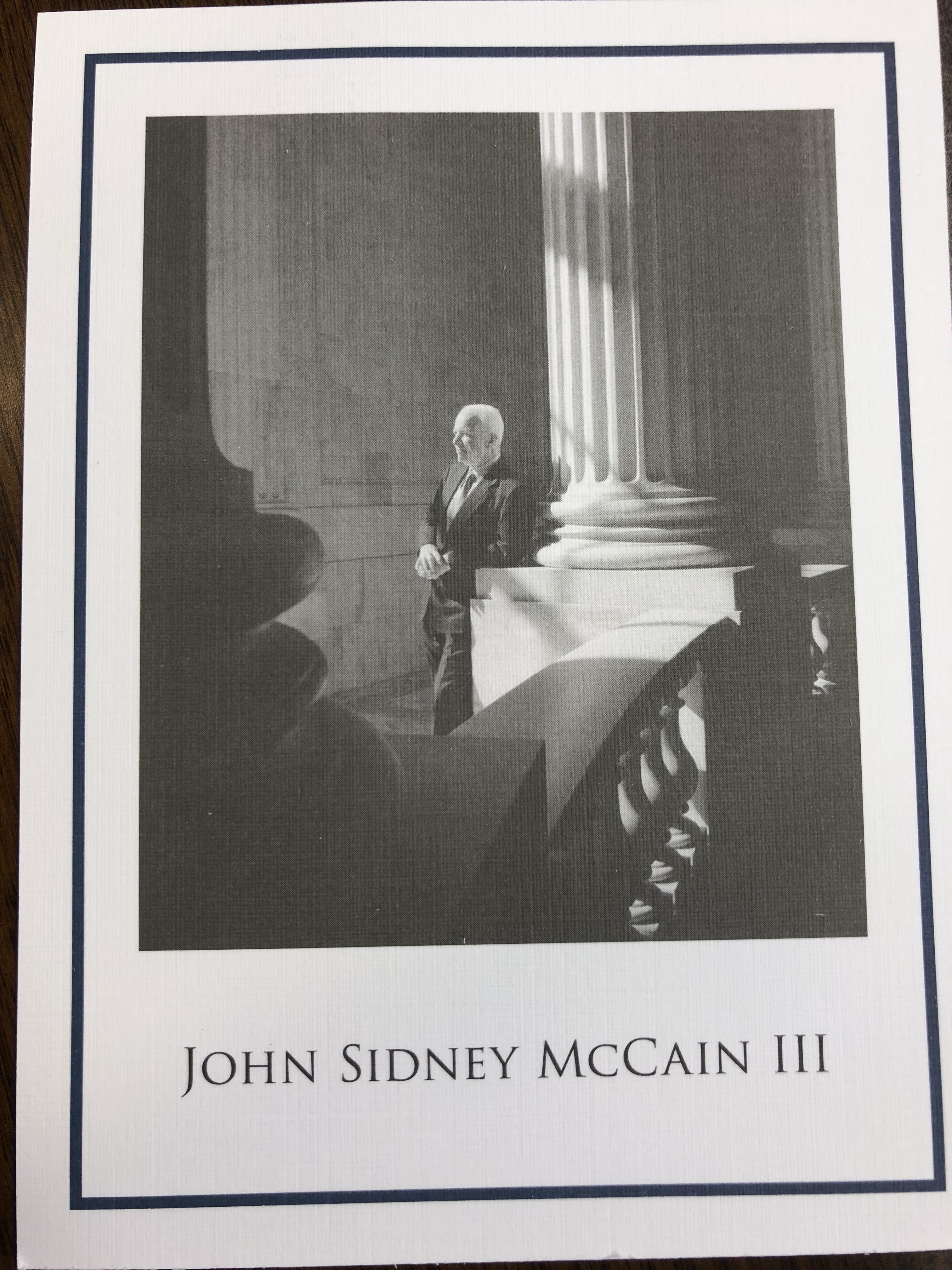
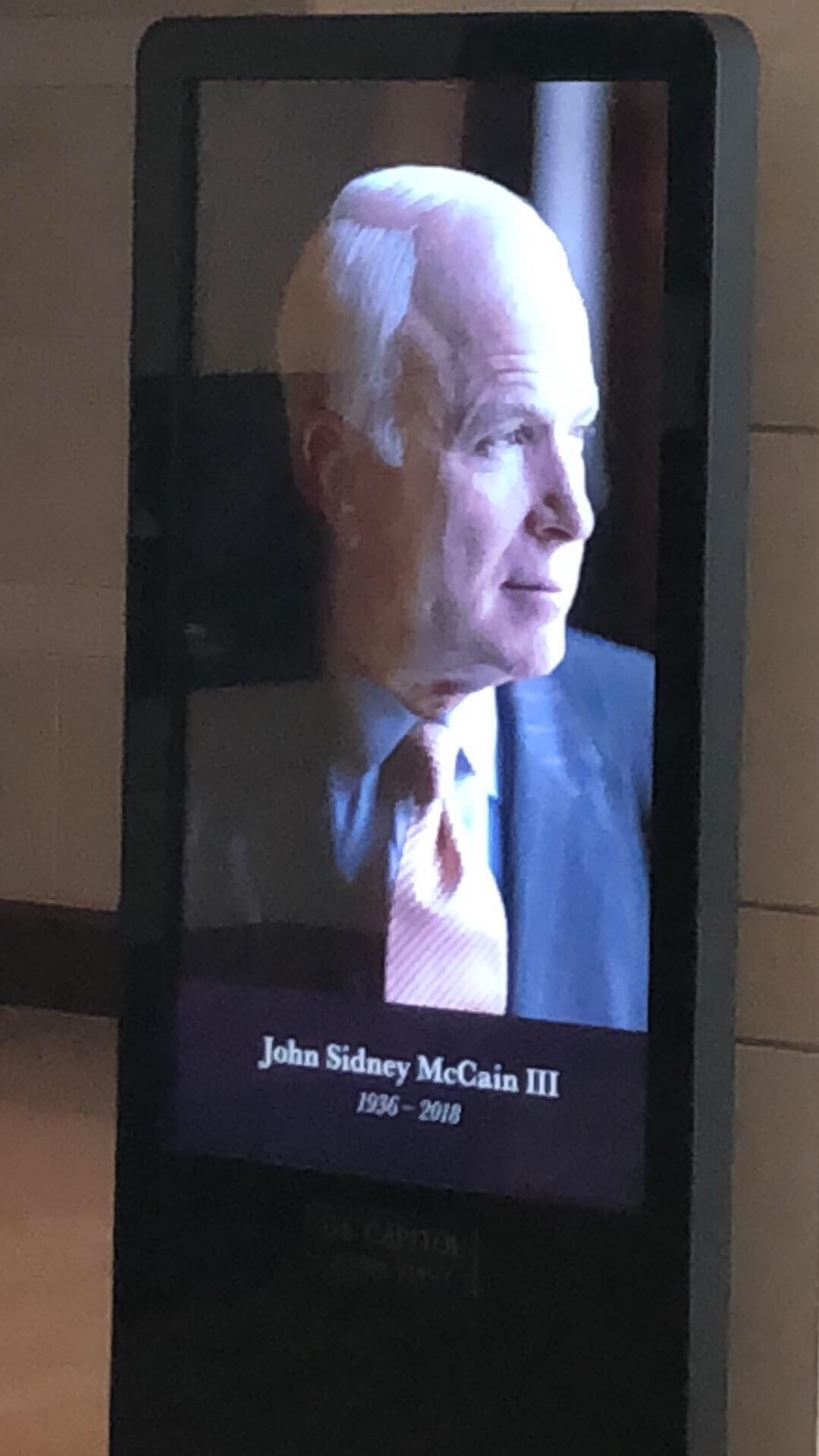
Honoring Senator John McCain

Metal barriers barricade 1st St NE/SE, the road directly east of the U.S. Capitol. Still almost an hour before the doors open to the public, the lines have already formed, snaking along the road between the Capitol Building and the Supreme Court and Library of Congress. The sun beats down, with only brief reprieves caused by the occasional cloud passing overhead.

Various types of people wait in line. A strong representation from military personnel. Vietnam War Veteran hats and shirts are prevalent. A few people are carrying signs. Undoubtedly, many of the attendees are D.C. beltway types and politicos, but a lot of people have traveled for the occasion. Most people have umbrellas for shade. There are also families with young children, some are young enough to be pushed around in strollers. They may not remember much from this day, but they are about to witness an honor bestowed only 30 times before.

There are many who are far more qualified to chronicle their memories of Senator John McCain. But as I wait the almost 2 hours to enter the Capitol rotunda, my mind reflects on my own reason for being here.


The 2008 election marked the first opportunity for me to vote in an election. Having only turned 18 in August of that year, I didn’t have the ability to vote in the primary election for my home state of California, which was held in February. So the first time I cast a ballot was in the November general election – in a presidential election! With my absentee ballot, (I was away at school in November and so had registered to vote absentee to vote locally in my home district) I marked a ballot for the first time for the Republican nominee and his running mate, John McCain and Sarah Palin. Truth be told, my support for McCain was buoyed by his selection of Sarah Palin as a running mate. Had I voted in the primary, I’m not certain that I would have ended up voting for McCain to be the nominee. As memory serves, the candidate quiz I took my senior year for Mr. Blasser’s government class suggested my preferences were most aligned with Governor Mitt Romney. The runner up in that exercise was Governor Mike Huckabee of Arkansas with Senator McCain as a close third. (It’s worth noting that one of the questions pertained to experience and I answered that having experience as a governor was a desirable trait, so if you played with the weighting of my responses, McCain could have come out ahead). But all that aside, when it came time to cast ballots in November, McCain was deserving of my vote. He was the right choice for the country.

Barack Obama’s election to serve as the first African-American President of the United States was an important, positive step for the country. And suggesting that John McCain was the better choice in that election should not take away from the historic outcome of the 2008 election. But elections have consequences. And to me, it seems that the country went in the wrong direction under the Obama Administration. Admittedly, it is not solely the fault of President Obama and his team. It is impossible to say for certain how the country would differ had the electorate gone with McCain in 2008, there are far too many variables for that, but I have to believe that the hyper-partisanship we now live with would not be as severe. John McCain was a Republican, but he was not a partisan. The reflections of many during his service, including that of former Vice President Joe Biden, reflected on his ability to reach across the aisle. His demeanor during his concession speech following the 2008 election is a testament to his character and the type of politician he was. If John McCain had been elected President of the United States in 2008, we would still see partisan politics practiced, but it’s safe to say that John McCain would have fought it to the best of his ability, and doing so from the position as chief executive would have gone a long way to mitigate the prevalence of partisanship.

I have had my share of disagreements with Senator McCain since public policy became my area of study and line of work. Chief among them, his decision to vote against Republicans’s effort to repeal parts of the Affordable Care Act in the spring of 2017. But his lifetime of service to this country is undeniable. And even though I may have disagreed with him on issues, the stance he took was a stance he believed to be right for the good of the country. In the end, reasonable people CAN disagree! Senator John McCain embodied this notion and served in Congress with a can do attitude. There’s a reason he has seen such an outpouring of support, regardless of partisan affiliation, since his passing.


I write this in part as a memory for myself. Out of respect, those paying their respects were asked to refrain from taking photographs in the rotunda.

img_0430

So my photo archive of the experience is limited, but the thoughts running through my mind remain. I hope that those who read this short blurb will be inspired to do their own reflection on the life and service of Senator John McCain. I am honored to have voted for him as President in the 2008 election and thankful for his years of service in the military and in public office.

N.B. Please excuse any typos or other errors. This was largely written while I stood in line outside the Capitol and did not get much in the way of proofreading.

The High Cost of Good Intentions: A History of U.S. Federal Entitlement Programs

In fall of 2017 I started a new position as manager of external affairs for the Hoover Institution’s Washington, D.C. office. A primary function of the D.C. office is to, “promote the academic work of Hoover fellows and to facilitate the engagement of fellows in the policy conversations that take place in the nation’s capital.” To a large extent, this involves hosting Hoover fellows from California, and on November 1, 2017 the first fellow we hosted in my tenure with the organization was John F. Cogan, the author of The High Cost of Good Intentions: A History of U.S. Federal Entitlement Programs. It took me a while to read the book, but quality time flying across the country for my first visit to Stanford University in an official capacity was the perfect setting to accomplish the bulk of the reading. (It’s fitting that I finished the first book I received on the job during the flight for my first visit to the main office, but if we’re being honest, I really should have finished the book a few months ago – no judging please!)


The book’s central theme is that the creation of entitlements brings forth relentless forces that cause them to inexorably expand.


Continue reading The High Cost of Good Intentions: A History of U.S. Federal Entitlement Programs