Tag Archives: Politics

The rematch? More like the comeback

Earlier this week, President Biden and former President Trump sewed up their respective nominations seemingly setting up a rematch of or sequel to the 2020 election. I say “seemingly” because I posit that it’s still possible, and I think likely, that the Democrat replace Biden at the Democratic National Convention, but I digress.

With the presumptive nominees now set, the notion of “the rematch” deserves some attention. The country already got one 2020 repeat earlier this year, when the San Francisco 49ers took on the Kansas City Chiefs in the Super Bowl. That did not go as I had hoped with the outcome also repeating itself as the Chiefs hoisted the Lombardi Trophy. Between the football and politics, 2024 is seemingly on a path to being “déjà vu all over again,” as Yogi Berra would say.

But Trump’s 2024 return to the ballot to take on his 2020 challenger is more than just a rematch. Billing it simply as just one of now seven repeat matchups misses an important characteristic: Trump is a former president! In most of those previous instances, the “rematch” involved a non-president taking on the incumbent he lost against before. The closest thing the repeat candidates had to presidential experience was losing their previous shot at the presidency.

For example, the perennial presidential candidate of the early 20th Century, William Jennings Bryan, one of the “rematch” examples (having matched up against William McKinley twice, and lost), never had the privilege of running as a former president. To return to a football comparison, William Jennings Bryan is the 90s Buffalo Bills of presidential nominees. The Bills represented the AFC in four straight Super Bowls from XXV to XXVIII, and they proceeded to lose every single one to the NFC East. It’s not a perfect analogy, because the Democrats had the good sense to nominate someone other than Bryan in 1904, but it’s still an apt comparison. The Bills might have made it to “the big dance” several times, but they were never Super Bowl Champions. The same can be said of Bryan who was a three-time nominee who never ascended to the presidency.

Notably, the Trump-Biden rematch differs in that President Trump has been America’s chief executive before. For that reason, 2024 is better considered a presidential comeback! And for that, there is only one comparison–the 1896 presidential rematch between incumbent Benjamin Harrison and former president Grover Cleveland, the outcome of which made President Cleveland the only nonconsecutive two-time president (so far).

With that, to prepare yourself for the upcoming election with a historical view, I recommend adding a Cleveland biography to your reading list. My choice, and a book I began reading this week, is A Man of Iron: The Turbulent Life and Improbable Presidency of Grover Cleveland by Troy Senik.

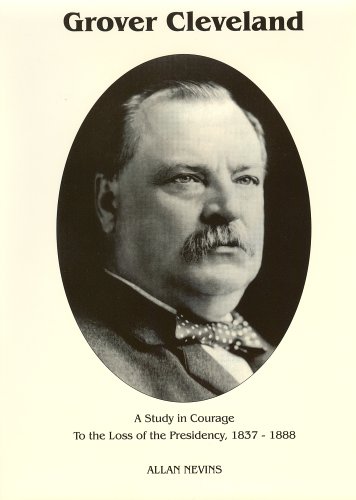
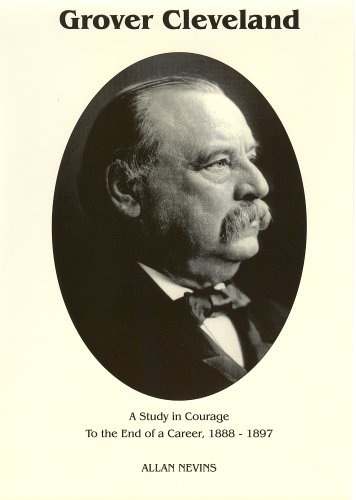
Alternatively, Allan Nevins’ 1933 Pulitzer Prize winning two-volume biography Grover Cleveland: A Study in Courage, which I read in 2022 in anticipation of this probability, is also a great choice.

To the Loss of the Presidency (Grover Cleveland a Study in Courage, Vol. 1) on Amazon: https://a.co/d/gsGMcFz
To the End of a Career (Grover Cleveland a Study in Courage, Vol. 2) on Amazon: https://a.co/d/gj1hLG7

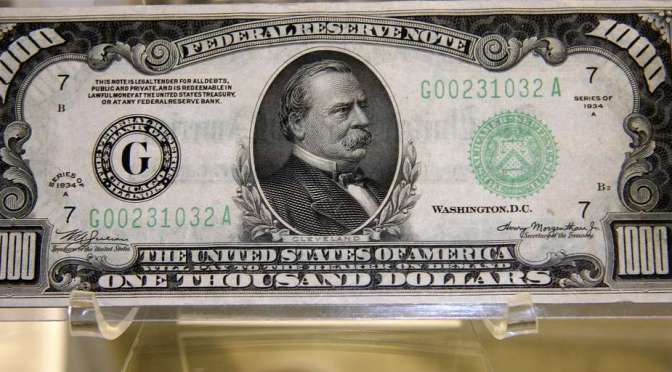
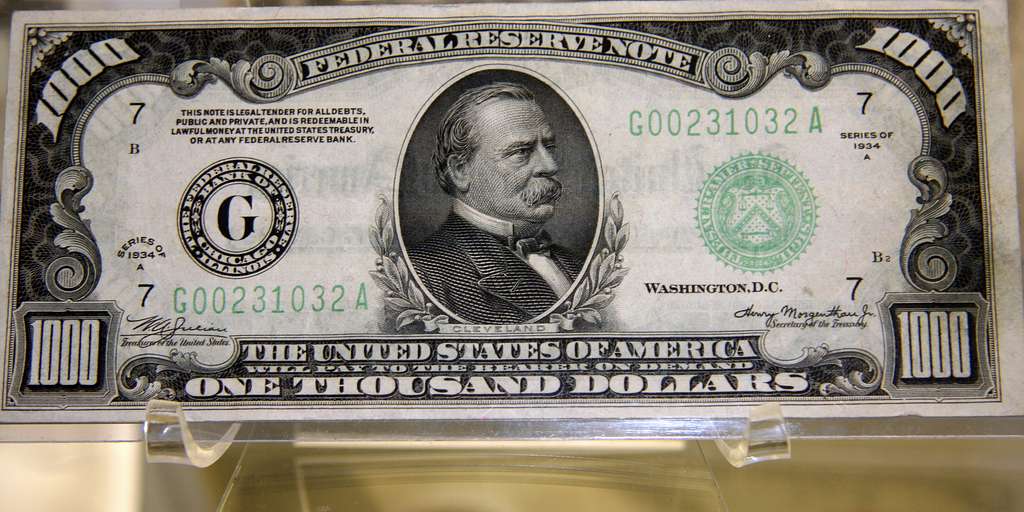
A closing fun fact: Grover Cleveland was featured on the $1,000 bill.

Although the $1,000 has been discontinued, the level of inflation since Biden took office might be making the case for out-of-circulation, high denomination bills, like the McKinley ($500 bill) and the Cleveland ($1,000), to make their own comeback.

New Article in the Federalist

Today, the Federalist published an article by my colleague Stewart Whitson and me discussing the House Committee on Administration’s recent hearing on Zuckerbucks and what states and Congress can do to prevent election interference. The Federalist has done a tremendous job shedding light on threats to election integrity, and I’m glad to be contributing to their continued efforts.

The article is available here: https://thefederalist.com/2024/02/22/congress-must-stop-the-big-corporate-election-interference-it-didnt-in-2020/.

Virginia’s New Grocery Bag Tax Irritates Me

In the past, at the dawn of a new year, I have set myself a goal to write regularly. That plan has always fallen flat thanks to lack of discipline and deference to competing priorities – but mostly lack of discipline.

For 2022, I made no such plans. And yet, here I am typing away at my keyboard as if to meet a weekly writing goal. But this post is not about sticking to a regular writing schedule. It is, however, inspired by what leads many great columnists to stick to theirs – irritation.

According to Washington Post columnist George Will, when asked the question, “How do you come up with things to write about?” William F. Buckley Jr. replied, “The world irritates me three times a week.” The implication being: write about what irritates you, and you will have sufficient material for a regular column.

The world irritates me three times a week.

William F. Buckley Jr. on the question, “How do you come up with things to write about?” according to George F. Will.

The source of my irritation is the new grocery bag tax plaguing northern Virginia.

I am generally irritated by taxes, but I find this new tax all the more bothersome, thanks to its timing. Earlier this week, I returned from California, where I spent Christmas and the New Year with my family. Family time is always rewarding but trips to California also come with reminders that the state has a penchant for bad policy – including its ban on plastic bags.

Usually, I do not do much grocery shopping while I am home. My typical encounter with the market occurs as a tag-along when my parents are shopping or on a one-off visit to pick up a few ingredients needed for dinner.

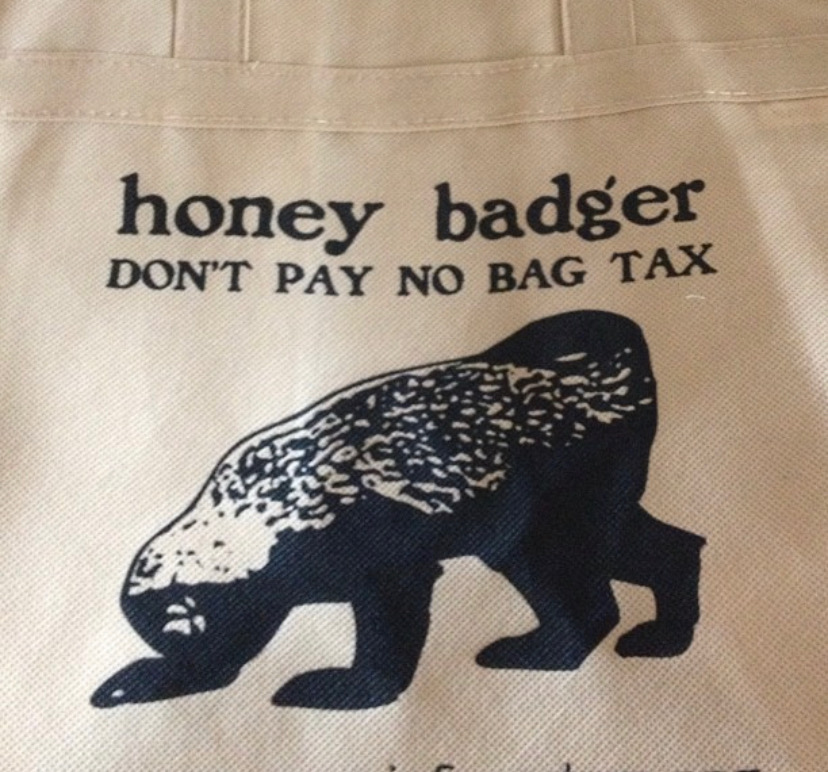
If I’m the one doing the buying, I grab only what I can carry without using a bag. Under the circumstances, I’m much more willing to shove items into my pockets and to walk away with overladen arms. Honey badger don’t pay no bag tax.

When I returned from my California visit, I thought I had left the plastic phobia behind me. Much to my dismay, at the self-checkout at my local grocery store in northern Virginia, I was confronted by a new prompt on the machine, asking me how many store-provided bags I used. It turns out, with the flip of the calendar, a new bag tax had taken effect.

Now, I tend to use reusable totes because they make it easier to carry my groceries on the walk home. But on this occasion, I was without my bags and found myself needing one that, a few days before, the store would have provided free of charge. So now, 10 cents later, I am irritated.

My opposition to the tax is more on principle than the cost. At 5 cents per bag, the tax will not break the bank. Regardless, it is still bad policy. Taxes should be about raising revenue to meet spending obligations, not social engineering. This new tax is really virtue signaling by Democratic politicians and environmental activists who circulated a petition to impose the tax following similar virtue signaling by the Virginia legislature and Democratic governor.

Arlington County, where I live, enacted the ordinance after receiving a petition with fewer than 1,500 signatories – not even 1 percent of registered voters.

A letter accompanying the petition claimed, “The plastic bag tax will encourage residents to shift to more sustainable, reusable bags…” Never mind that reusable bags are unhygienic and require nearly 200 years of regular use before achieving an overall environmental benefit.

I’m also dubious that the tax will reduce the prevalence of grocery bags that supposedly “litter our streets and open spaces.” When San Francisco banned single-use bags, the reduction in plastic bags comprising the city’s litter was statistically insignificant. Besides, the “nasty streets” of San Francisco have bigger problems than plastic bags.

Reportedly, revenue for the tax will be used for environmental cleanup programs, pollution and litter mitigation programs, educational programs, and to provide reusable bags to SNAP and WIC beneficiaries. But so what? If the tax is supposed to eliminate plastic bag usage, then the beneficiaries of the revenue are irrelevant. Really the tax pays for pet projects that make “environmentalists” feel good.

Of course, all of this ignores what the new tax portends for grocery-inspired comedy. Inevitably, grocery clerks will assume customers will want to avoid bagging large items such as the cumbersome gallon of milk. After all, it already comes equipped with a handle. As a result, they will forego the standard question: “Would you like the milk in a bag?” Leaving dad-joke aficionados without an opportunity to supply the always humorous response, “No, thanks. Just leave it in the container.”

Did anyone mention this to the petition signatories while they signed on to the death of comedy in exchange for an “environmentally friendly” bag tax?
Content Added

After a long hiatus, I am pleased to provide new content to my website. This post announces updates to the Publications Archive page. The page had been underdeveloped for some time. Previously, my publication archive only listed two of my publications Taxes talk, but players like Bryce Harper still want to play where their lights shine brightest published in the Washington Examiner and Why conservatives can cheer California’s single-payer health care bill which I co-authored with Robert Graboyes for the Sacramento Bee. When I originally published the archive of my published work, these two articles were both my most recent publications and also the only articles for which I had easy access. Things have changed since then.

This update is in part prompted by a change in work. I recently began a new role as Senior Fellow at the Foundation for Government Accountability. In this position, I will be authoring original research and occasional opinion pieces. My first to briefs co-authored with Hayden Dublois are now included. We write about some interesting stuff related to the 2020 election.

Accordingly, I intend to update this website with links to my FGA content. Linking to my professional publications will likely be the majority of new posts; however, I will also try to populate my blog with additional commentary. Importantly, the opinions included on this webpage are my own, and do not express the views or opinions of my employer.

Another cause for updating the publications archive was to fill in some of the missing publications. I was fortunate to recently discover the landing page for the articles I wrote for Mic.com (Policy Mic at time of publication). Those have now been added. Additionally, I found a way to access my writings for The Vista, University of San Diego’s student newspaper. My 2011 article about Solyndra came up in a Google search and from there I was able to reverse engineer how to find my writings on the Vista archive. It’s amazing what you can find when you take the time to look.

The new and improved Publication Archive page may still have some gaps, but it is now more robust with these recent additions. Happy reading and stay tuned for new content soon.

Are you really that offended by your college’s mascot?

Apparently, George Washington is an offensive mascot. As reported by Campus Reform, students at George Washington University are petitioning to have the name changed on the grounds that the “Colonial” mascot may not be “the best identity for community school spirit.”

Source: Fox & Friends Facebook Page

One of the students interviewed in the Campus Reform video claimed, “there are students on this campus who don’t feel comfortable with it, so then, it doesn’t really matter what other students think.” To me, this raises the question, how offended can someone really be? Didn’t they voluntarily enroll at GW knowing full well that the mascot is the “Colonial”?

By all means, let’s have the debate over “offensive” mascots. But arguing that some are offended does not really justify a change. For one, it ignores the opinions of those who don’t have a problem, or even like the mascot. And what’s more, those who are offended by the name are not obliged to attend an institution whose traditions make them uncomfortable. With some 5,300 colleges to choose from, enrollees are hardly coerced to study there.

The offended students would do well to remember that they chose to enroll at GW University, “Colonial” mascot and all. If they had any qualms about the mascot, they clearly weren’t that significant. By enrolling, those students implicitly ranked their discomfort with the school’s mascot on a lower rung when considering the myriad trade-offs prospective students face. Had it been an important enough issue, the students would have given better consideration to that factor when making their enrollment decision.

This is not to say that schools and teams shouldn’t undergo name changes. As the GW Libraries website points out, the “Colonials” was not the original name used to refer to GW’s sports teams and the school itself was not always George Washington University. But the decision should not hinge on the discomfort of a few students.

As for ascribing the “Colonial” mascot to GW sports teams, a 1926 editorial from the school newspaper, The Hatchet, offers a pretty solid explanation for the name:

What name could be more fitting? This, the school named after George Washington, and having as its colors the Continental Army buff and blue, the colors of Colonial America, should be entitled to bear the name of “Colonials” if any school is so entitled. George Washington University, in its antecedents, is a colonial school. Dating back to very early post-Revolutionary days, it was founded when the term “colonial” still applied to an era which was then passing. Let us then, in just regard for our precious heritage, adopt as the name for the warriors wearing the Buff and Blue the term “Colonials.”

Excerpt from an editorial in the Hatchet from October 27, 1926. Source: https://library.gwu.edu/scrc/university-archives/gw-history/nicknames-and-mascots

Choosing a New Majority Leader – Is McCarthy the ‘Right’ Choice?

The primary race in Virginia’s 7th Congressional District took a shocking turn when challenger Dave Brat overcame the odds and won against not only an incumbent but the sitting Majority Leader of the House of Representatives.

Image

Cantor’s stunning defeat is viewed as a major victory for the grassroots and Tea Party activists but while the movement may have had the power to remove the establishment candidate from leadership, they are likely to be unsuccessful in playing a meaningful role in choosing his successor.

The immediate and obvious choice following Cantor’s loss was to promote the House’s number three, Rep. Kevin McCarthy (R-CA), to the number two position. In the early days of this short race it appeared McCarthy’s ascension might be challenged by a pair of Texans, House Rules Chairman Pete Sessions (R-TX) and House Financial Services Chairman Jeb Hensarling (R-TX). In the end however, both potential challengers dropped their bids essentially giving McCarthy a clear path to the Leadership.

But is McCarthy the “right” choice for Majority Leader?

McCarthy is obviously not Eric Cantor and takes different stances on certain issues, but he is also Cantor’s handpicked, anointed successor. And replacing Cantor with McCarthy is sure to anger the activists who fought to see Cantor unseated and are the same folks that will be relied upon to help the Republicans maintain control of the House and take over the Senate in the mid-term elections. As Washington Examiner Senior Writer Philip Klein wrote:

It would be bizarre if instead of going in a new direction after this stunning defeat, House Republicans just rallied around Cantor’s own pick. It’s especially demoralizing to conservatives whose energy the GOP will need this November.

It now appears that the lone challenge to McCarthy’s claim for Majority Leader is Raul Labrador of Idaho who officially entered the race with about a week remaining before the caucus vote. Labrador serves as the conservative alternative to McCarthy though at this point it will be difficult for him to manufacture enough support to mount a serious challenge.

The conventional wisdom is suggesting that Labrador is indeed a long shot for the position and that the GOP will ultimately elect McCarthy as Majority Leader for the remainder of the 113th Congress with the possibility of shaking up the leadership in the next Congress.

Whether this tactic is sufficient for the conservative base remains to be seen. Brat’s stunning upset victory gave the conservative wing of the House caucus an opportunity to really shake up the leadership and insert a member that is outside of the establishment and more in-line with the base. In the end this may be just another example of the GOP snatching defeat from the jaws of victory.

The August Employment Situation: Still Weak Despite Favorable Unemployment Numbers

While the unemployment rate, 7.3 percent, has fallen to its lowest level since December of 2008, it is important to remember that the unemployment rate is, and has been, a poor measure of job growth in the current recession. Relying only on the unemployment rate fails to account for those who have dropped out of the labor force due to poor employment prospects.

It is more appropriate to look at the employment rate and measure the labor force participation, which is the share of working-age people in the labor force. While this also includes those of working-age that might not participate in the working force even in a more favorable job market, it is more encompassing, making it a better indicator.

The August jobs numbers show that participation in the US dipped from 63.4 percent down to 63.2 percent, the lowest since August 1978. This is coupled with lower than expected job growth, painting a grim employment picture.