Tag Archives: SF Giants

Thoughts on the Giants’ revamped rotation

Recently, I suggested a savvy option for the Giants to upgrade their starting rotation. Thankfully, they went in a different direction and landed the reigning National League Cy Young award winner Blake Snell. In fairness to my position, at the time of my writing, I still thought Snell would be a good signing. Here’s how I ended that post:

I would certainly be happy with the Giants signing either Snell or Montgomery–heck, go for both–but I also understand the constraints. The bottom line is that the Giants need a starter, and Michael Lorenzen would be a good fit to fill that need.

– Me (two weeks ago)

But I was also well aware that the Giants have had their struggles landing the big name free agents lately. Last winter included the major disappointments of Aaron Judge resigning with the Yankees and the mega deal for Carlos Correa disintegrating overnight. This winter appeared to be going the same direction with both Shohei Ohtani and Yoshinobu Yamamoto agreeing to deals with the rival Dodgers (although, with Yamamoto getting shelled in his debut and the gambling drama surrounding Ohtani, neither seem like huge losses for the moment).

Even as the Giants and Snell remained a speculative pairing, the prospect became dimmer as the offseason wore on. The Giants had quietly made some moves on both sides of the ball and appeared to have assembled a rotation the team was comfortable rolling with to start the season. Or at the very least, they were comfortable selling it to the fan base–Snell is completely absent from a “Building the Giants Pitching Rotation” propaganda video that was released two days after he officially donned the orange and black.

All but a few sands in the Spring Training hour glass had fallen and other teams were also still in the mix. Until they weren’t. And Blake Snell was a Giant!

Even if Snell isn’t quite ready for Opening Day, his addition is a huge boost to a rotation that, in my opinion, was sporting more question marks than answers. According to MLB.com, having Snell in the fold merits ranking the Giants at number five in its rotations rankings–I think they should be higher.

Just a short time ago, the projected rotation looked much different. One projection penciled in the five spots this way:

  1. Logan Webb
  2. Ross Stripling
  3. Kyle Harrison
  4. Tristan Beck
  5. Keaton Winn

Between injuries and roster moves, including the Blake Snell addition, it’ll be a much different look (at least on paper, the placements might be off to start the season while guys get settled in).

  1. Logan Webb
  2. Blake Snell
  3. Jordan Hicks
  4. Kyle Harrison
  5. Keaton Winn

Things will look even different when/if everyone comes back healthy and the pitching staff is at full strength. Alex Cobb is reportedly ahead of schedule and Robbie Ray is still expected back in the second half. Having an All Star and Cy Young winner waiting in the wings gives the Giants an even more formidable rotation and plenty of depth.

I am always optimistic heading into a new baseball season, but I’m especially excited thanks to the pitching and defensive moves the front office made. The old adage, defense wins championships, is true. Pithing and defense were at the core of the 2010, 2012, and 2014 World Series Championships. That should be the model. Especially with the Giants playing half of their games at Oracle Park. Between the pitching upgrades and a left side of the infield sporting multiple Gold Gloves, the Giants could be on their way to competing for another Fall Classic.

The Giants should start the season with another starter in the rotation

Heading into the 2024 season, the Giants’s rotation was certainly in need of an upgrade. The 2023 starters were below average in quality starts (6 innings and fewer than 3 runs) and ranked third from the bottom in wins in games started. Some of that statistical poor showing has to do with the outsized use of the “opener.” Even still, Kapler’s reliance on the “opener,” in addition to him being a poor decision-maker, was mostly a symptom of a weak rotation–Wood, Manaea, and Stripling would have been starting games outright if they were performing.

But there were bright spots. Giants starters led the league in complete games (4), with Logan Webb (who should have been an All-Start and was the Cy Young runner-up) and Alex Cobb (first-time All-Start) logging two apiece. Both also threw for more than 150 innings (Webb led the league with 216 innings pitched). As spring training rolls along, Webb is a lock to make his third consecutive Opening Day start.

Some of the necessary changes have been made. All of the “featured pitchers” from the “opener” experiments have gone elsewhere. The Giants landed the 2021 Cy Young winner Robbie Ray by trading injury-ridden Anthony DeSclafani and outfielder Mitch Haniger to Seattle. They also brought on flame-throwing right-hander Jordan Hicks on a four-year deal with the intention of using him as a starting pitcher.

If everyone was healthy, the starting rotation would look something like this:
1. Logan Webb
2. Robbie Ray
3. Alex Cobb
4. Jordan Hicks
5. Kyle Harrison

But with less than a month before Opening Day, the Giants are rolling in with a skeleton crew. Instead, the rotation is:
1. Logan Webb (lock)
2. Jordan Hicks (reliever turned starter)
3. Kyle Harrison (unproven)
4. ?
5. ?

And after spring training injuries have taken their toll, some of the leading contenders for those rotation slots to fill in for Ray and Cobb are now on the shelf themselves. The Giants should add another starting pitcher!

The three names that I’ve heard most frequently linked to the Giants are Blake Snell, Jordan Montgomery, and Michael Lorenzen. At this juncture, I think Lorenzen makes the most sense.

There are a couple of different ways to go about constructing a roster. One approach is to stockpile talent and sign the best players regardless of position and then try to move talent around after the fact. That seems to be what the Giants did with their signing of Matt Chapman despite already having a quality starting third baseman on the roster. On the one hand, you’ve got a better team (at least on paper) and plenty of depth. But there are constraints to stockpiling talent. After all, there are only 9 spots on the lineup card and only 9 innings per game (usually) for pitchers to pitch.

If the Giants want to stick with the “most talented” approach, they should nab Snell or Montgomery. Statistically, they had the better 2023 campaigns–although, of the trio, Lorenzen was the only All-Star. But given the current roster, Lorenzen makes plenty of sense. He would slot in as a quality starter immediately, but he would also be a good depth piece for a rotation with injury issues and several question marks. As players return from injury, he could remain a starter or, given his experience as a set-up man, move to the bullpen. That kind of flexibility is helpful over a 162-game marathon is a tremendous asset. He’s also viewed as a more cost-effective option. MLBTR predicted a two-year, $22 MM contract earlier in the offseason.

Lorenzen had his struggles last year, mostly in the second half, but he also had flashes of brilliance, e.g., throwing a no-hitter in his second start after being traded to the Phillies. It’s possible that those struggles were a consequence of wearing down. Before last season, he had only thrown more than 100 innings once in his career, and that was his rookie season with the Reds back in 2015. If the Giants bring him aboard, he’ll pencil in at the back end of the rotation, where usage and late-season fatigue will be of less concern.

I would certainly be happy with the Giants signing either Snell or Montgomery–heck, go for both–but I also understand the constraints. The bottom line is that the Giants need a starter, and Michael Lorenzen would be a good fit to fill that need.

The Giants bring on Matt Chapman

After all the speculation and rumors linking Matt Chapman to the San Francisco Giants, the four-time gold glove third baseman is finally headed back to the Bay.

Time will tell if this move pays off. I have my doubts.

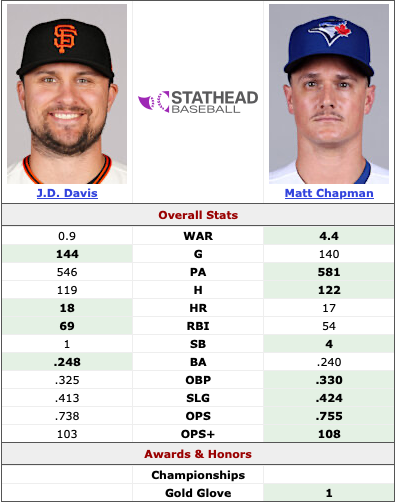
The Giants already have incumbent third baseman J.D. Davis on the roster for a more modest salary. While Chapman is reportedly coming in on a three-year, $54 million contract ($20 million in 2024), Davis is only slated to take home $6.9 million this season. Does Chapman improve the roster by the additional $13 million he’ll be paid next year?

Measured by career numbers, Chapman certainly has the edge on Davis. Both players are the same age, but Chapman has logged significantly more major league experience. He’s also more impressive defensively.

But more recent numbers paint a picture of Chapman as a more expensive Davis with a better glove. In fewer plate appearances last season, Davis put up comparable numbers and was also vying for a spot on the NL All-Star team before coming up short in voting for the Summer Classic.

Chapman’s defensive prowess cannot be ignored. Last season, the Giants were the worst team defensively, logging 117 errors. While Davis contributed to that total with 9 errors of his own, his numbers do not look all that different from Chapman’s (who won his fourth gold glove last season). Chapman recorded 12 errors across 1214 innings at third base (300 more than Davis, who also spent 30 games between first base and DH) and .968 FPCT. Davis had a .967 FPCT at third base and although he clocks in below Chapman on the “range factor” metric, he made strides in the field last season and proved to be a capable defensive third baseman.

Some speculated that signing Chapman and his superior glove makes even more sense, given the uncertainty surrounding Marco Luciano as the heir apparent at shortstop. However, it seemed to me that the Giants had already hedged against that by bringing in two-time Gold Glove winner Nick Ahmed on a minor league contract.

Because Davis can also play first base, the Giants could retain him in more of a utility and depth role, but that route is complicated by the presence of Wilmer Flores.

While it’s true that Wilmer is more of a defensive liability at the hot corner (a .928 fielding percentage and a career-low .848 in 2023), he’s coming off of a great offensive second half and has been the clubhouse guy that successful teams need. Look no further than his recruitment efforts to bring on Jorge Soler — a bat that would encroach on Wilmer’s DH opportunities — as evidence of his team-first mentality. With a 2024 salary of $6.5 million, he is also the lowest-priced of the three. If the Chapman signing spells the end of Wilmer’s time in San Francisco, then count me out on the deal.

The bottom line: The Chapman signing raises just as many questions as it answered. The Giants now have a surplus at third base and making a trade to clear up defensive assignments seems to be the next order of business. But who are the Giants going to part with, and what can they expect in return? Seemingly, the Giants will be able to find a suitor, but will that trade fill other pressing roster needs, i.e. starting pitching, and balance out Chapman’s more expensive contract?

Signing Matt Chapman could be the right move. He is a team leader and has history with new manager Bob Melvin from their time together in Oakland. As the 2024 season progresses, an offensive resurgence and Chapman’s intangibles might prove he’s worth the money. As a Giants fan, I’ll hope for the best, but I’m skeptical that this was much of an improvement.

Should the Giants Be Sellers at the Deadline? This fan Says, NO!

Major League Baseball’s Trade Deadline is a week away. The elimination of the waiver trade period, effectively making July 31st the only trade deadline, will force teams to decide whether they will use the deadline to make playoff run improvements or start planning for the future. For much of the 2019 campaign baseball commentators have speculated that the San Francisco Giants will be sellers at the deadline and that impending free agent Madison Bumgarner, among others, will be traded away to help replenish a farm system for a team in need of a rebuild. But is that still the case?

The post All-Star Game surge (11-2 since the break), which really began before the break with a sweep of the Padres to kick off July (the Giants’ first 3-game series sweep of the season), has complicated the “Giants are sellers” narrative. As the team continues to find ways to win games, fans and commentators alike are starting to think that a playoff spot might be within reach after all.

The Giants had a tough start to the season, going 22-34 through May but have turned it around with a winning record in June (14-13) and the aforementioned hot start to July (16-3, so far). Finding the right pieces seems to be the reason for the success. There was a lot of roster turnover in the early goings, so much so that The Mercury News ran a headline, “Reckless or relentless? Giants’ approach to roster raising questions” back in mid-April. But the roster has gained some stability as of late. To be sure, roster moves have continued – marginal players have been designated for assignment or sent down, and there have been some rookie call ups – but for the most players have settled into their roles. That all could change next Wednesday.

As a fan, you want your team to succeed in present, but you also hope that management will keep an eye toward the future. That’s what makes a Trade Deadline decision tough because to bring in that missing piece for a playoff run, you often have to part with valued prospects or draft picks. Writing for MLB.com, Mike Petriello predicts what seems like the ideal outcome for fans:

Our guess is that Zaidi will thread the needle by doing a little of both. He’ll deal from the team’s strong bullpen, but he won’t receive the offers he wants for Bumgarner, in part due to concerns that his reputation outweighs his 2019 performance, specifically his low fastball velocity (91.6 MPH) and high hard-hit rate (just 14th percentile). Throw in the X-factor of Bumgarner’s limited no-trade clause, and Zaidi will keep a franchise icon and extend him a qualifying offer that Bumgarner probably won’t accept this winter, meaning that at least a Draft pick will be coming back. Maybe he even signs an extension.

20 player, 20 Trade Deadline predictions by Mike Petriello via MLB.com. Links are original to Petriello’s posting.

This has been Zaidi’s approach to managing the roster so far. He has sought out players to improve on the margins in order to put a competitive team on the field. With the additions of big time contributors (Kevin Pillar, Mike Yastrzemski, and Alex Dickerson), combined with timely call ups and excellent management by Bruce Bochy, the Giants have gone on a run to pull within a few games of a Wild Card spot.

As of this writing, the chance that the Giants make the playoffs are slim, but also improving. According to popular metrics websites:
Baseball Reference: 13.0%
FanGraphs: 9.3%
FiveThirtyEight: 10%

Those aren’t great odds, but the optimistic fan holds out hope. The run might not be sustainable, but then again, it might be. Players who had been underperforming are finding their stride. Johnny Cueto could return in September. All I’m saying is the team is playing well, it’s Bochy’s final season, and there’s a chance. Let’s see what this team can do!

Source: http://giphygifs.s3.amazonaws.com/media/ToMjGpKniGqRNLGBrhu/giphy.gif

Are you really that offended by your college’s mascot?

Apparently, George Washington is an offensive mascot. As reported by Campus Reform, students at George Washington University are petitioning to have the name changed on the grounds that the “Colonial” mascot may not be “the best identity for community school spirit.”

Source: Fox & Friends Facebook Page

One of the students interviewed in the Campus Reform video claimed, “there are students on this campus who don’t feel comfortable with it, so then, it doesn’t really matter what other students think.” To me, this raises the question, how offended can someone really be? Didn’t they voluntarily enroll at GW knowing full well that the mascot is the “Colonial”?

By all means, let’s have the debate over “offensive” mascots. But arguing that some are offended does not really justify a change. For one, it ignores the opinions of those who don’t have a problem, or even like the mascot. And what’s more, those who are offended by the name are not obliged to attend an institution whose traditions make them uncomfortable. With some 5,300 colleges to choose from, enrollees are hardly coerced to study there.

The offended students would do well to remember that they chose to enroll at GW University, “Colonial” mascot and all. If they had any qualms about the mascot, they clearly weren’t that significant. By enrolling, those students implicitly ranked their discomfort with the school’s mascot on a lower rung when considering the myriad trade-offs prospective students face. Had it been an important enough issue, the students would have given better consideration to that factor when making their enrollment decision.

This is not to say that schools and teams shouldn’t undergo name changes. As the GW Libraries website points out, the “Colonials” was not the original name used to refer to GW’s sports teams and the school itself was not always George Washington University. But the decision should not hinge on the discomfort of a few students.

As for ascribing the “Colonial” mascot to GW sports teams, a 1926 editorial from the school newspaper, The Hatchet, offers a pretty solid explanation for the name:

What name could be more fitting? This, the school named after George Washington, and having as its colors the Continental Army buff and blue, the colors of Colonial America, should be entitled to bear the name of “Colonials” if any school is so entitled. George Washington University, in its antecedents, is a colonial school. Dating back to very early post-Revolutionary days, it was founded when the term “colonial” still applied to an era which was then passing. Let us then, in just regard for our precious heritage, adopt as the name for the warriors wearing the Buff and Blue the term “Colonials.”

Excerpt from an editorial in the Hatchet from October 27, 1926. Source: https://library.gwu.edu/scrc/university-archives/gw-history/nicknames-and-mascots